Titrimetric (Volumetric) Methods of Analysis
Term 1 - 2026
Course learning objectives
- Explain the basic principles of titrimetric analysis
- Discuss criteria for selecting primary standards
- Interpret potentiometric, thermometric and conductometric titration data
- Perform titrimetric experiments including standardization and back titration
- Perform calculations based on titrimetric data, including back titration calculations
- Cite real-world examples of titrimetric analysis
Titrimetric (Volumetric) Methods of Analysis
Four 80-minute lessons covering the principles, primary standards, instrumental endpoint methods, practical standardization and back titration, back titration calculations, and applications of titrimetric analysis.
L1 · Principles of Titrimetric Analysis & Instrumental Endpoint Methods9 content · 5 resources
Lesson objectives
- Explain the basic principles of titrimetric analysis
- State and justify the criteria for selecting a primary standard
- Identify NaHCO3, Na2CO3, KIO3 and oxalic acid (and its salts) as primary standards
- Interpret potentiometric, thermometric and conductometric titration curves to locate an equivalence point
Syllabus objectives covered
- 2.1 — explain the basic principles upon which titrimetric analyses are based
- 2.2 — discuss the criteria used in selecting primary standards
- 2.3 — use data obtained from potentiometric, thermometric and conductrometric methods for titration which do not require the use of indicators
What is a titrimetric (volumetric) analysis?
Titrimetric (volumetric) analysis is a quantitative technique in which the volume of a solution of known concentration (the standard solution) required to react completely with a measured amount of analyte is used to determine the amount, or concentration, of that analyte.
The point at which chemically equivalent amounts of the two reactants have combined is called the equivalence point. The point at which this is observed experimentally (by colour change, or by an instrumental signal) is called the endpoint, and is ideally as close as possible to the equivalence point.
Primary Standard vs Standard Solution
A primary standard is a highly pure, stable substance that can be weighed accurately and used directly (or to standardize another solution) because its exact concentration can be known from its mass alone.
A standard solution is simply any solution of accurately known concentration – it may be made from a primary standard directly, or standardized against one (a secondary standard), as with sodium hydroxide, which is never a primary standard.
Criteria for a Primary Standard
A substance is suitable for use as a primary standard if it:
- is available in a high state of purity;
- is stable at room temperature and does not decompose, oxidize or absorb moisture or from the air (i.e. it is non-hygroscopic and non-deliquescent);
- has a relatively high molar mass, so that weighing errors are minimized;
- reacts completely and in a known, stoichiometric manner with the substance being determined;
- is readily soluble in the solvent being used (usually water).
Examples: sodium hydrogen carbonate (NaHCO₃), anhydrous sodium carbonate (), potassium iodate (), and oxalic acid dihydrate () and its salts.
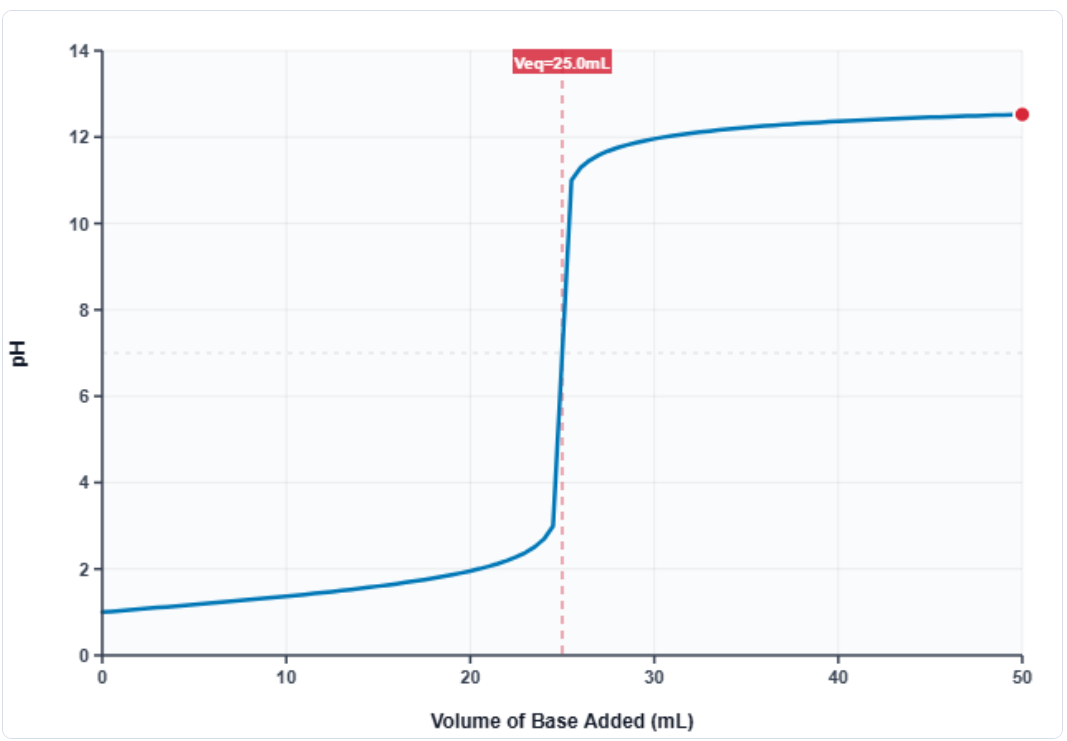
Potentiometric titration curve
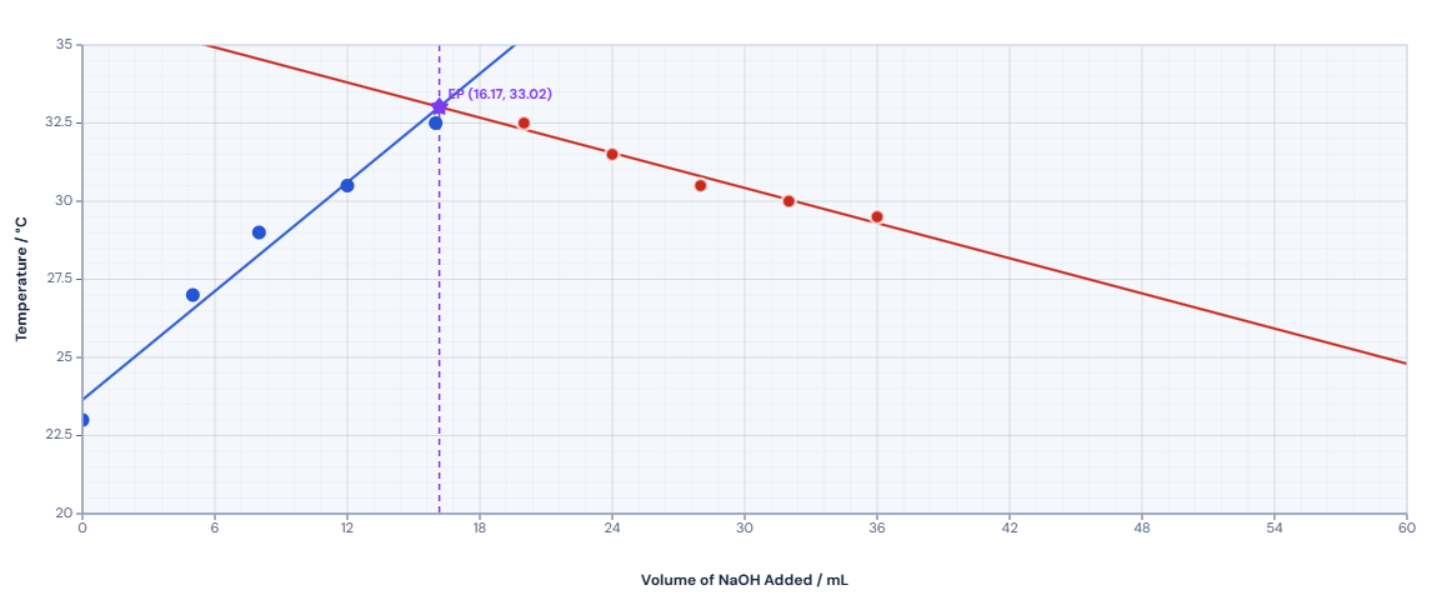
Thermometric titration curve
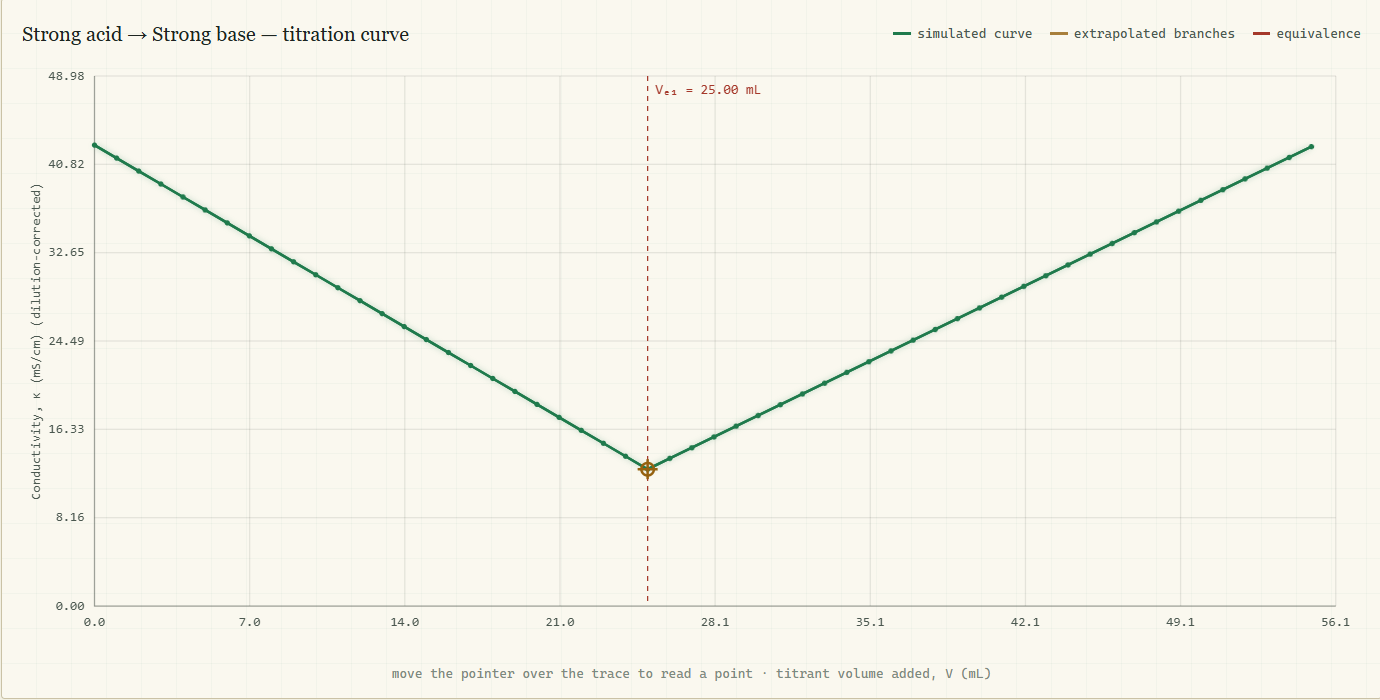
Conductometric titration curve
Reading an equivalence point from a graph
On a potentiometric curve, the equivalence point is the volume at which the pH-vs-volume graph is steepest (the point of inflection) – this can be located precisely using a first-derivative (ΔpH/ΔV) plot. On a conductometric curve, the equivalence point is the volume at the intersection of the two straight-line portions of the graph, since ions are being replaced by ions of different mobility before and after the reaction is complete.
Primary Standard or Not?
Quick Check
Resources
L2 · Practical: Standardizing Sodium Hydroxide with Oxalic Acid5 content · 1 resources
Lesson objectives
- Prepare a standard solution of oxalic acid dihydrate by accurate weighing and volumetric technique
- Carry out an acid-base titration to standardize a sodium hydroxide solution
- Calculate the molar and mass concentration of the standardized NaOH solution
Syllabus objectives covered
- 2.4 — perform experiments based on titrimetric analyses
- 2.5 — perform calculations based on data obtained from titrimetric analyses
Why standardize sodium hydroxide?
Sodium hydroxide is hygroscopic and readily absorbs carbon dioxide from the air to form sodium carbonate, so a freshly made NaOH solution never has exactly the concentration you intended. Because of this, NaOH cannot be used as a primary standard – instead, its concentration must be found by titrating it against an accurately prepared standard solution of a suitable primary standard, such as oxalic acid dihydrate.
Reaction between oxalic acid and sodium hydroxide
Practical technique checklist
Before you begin, review the key volumetric skills you will need today:
- Taring the balance and weighing accurately to the nearest 0.01 g
- Transferring solid quantitatively into a volumetric flask, including rinsing the beaker and funnel
- Filling a volumetric flask to the calibration mark, reading the meniscus at eye level
- Rinsing and filling a burette correctly, and reading it to the nearest 0.05 mL
- Titrating slowly near the endpoint and recognising a permanent, pale pink colour with phenolphthalein
Finding the concentration of NaOH from titration data
Quick Check
Resources
L3 · Back Titration: Calculations and Applications8 content · 2 resources
Lesson objectives
- Explain when and why a back titration is used instead of a direct titration
- Calculate the amount/purity of an analyte from back titration data
- Cite real-world examples of back titration (antacids, fertilizers, carbonate purity)
Syllabus objectives covered
- 2.1 — explain the basic principles upon which titrimetric analyses are based
- 2.5 — perform calculations based on data obtained from titrimetric analyses
- 2.6 — cite examples of the use of titrimetric analysis in the quantification of various substances
What is a back titration?
A back titration (reverse titration) is used to find the amount of an analyte by reacting it with a known excess of a standard reagent, then titrating the unreacted excess of that reagent against a second standard solution. The amount of reagent that reacted with the analyte is found by difference: (moles of reagent added) − (moles of reagent left over, from the second titration).
When is back titration used instead of direct titration?
- The reaction between analyte and titrant is too slow for a direct endpoint
- There is no suitable indicator for the direct reaction
- The analyte is insoluble and cannot be titrated directly
- The analyte is volatile and would be lost during a direct titration
- The direct reaction is between a weak acid and weak base, giving no sharp endpoint
Worked Example 1: Calcium carbonate content of an indigestion tablet
An indigestion tablet is crushed and reacted with 25.0 mL of 1.00 mol/dm3 HCl (a known excess). The unreacted HCl is titrated against 0.500 mol/dm3 NaOH, requiring 25.80 mL.
Step 1 – initial moles of HCl added: n = × 1.00 mol/dm3 = 0.0250 mol.
Step 2 – moles of NaOH used to neutralise the excess HCl: n = 0.02580 dm3 × 0.500 mol/dm3 = 0.01290 mol. Since HCl + NaOH react 1:1, moles of excess HCl = 0.01290 mol.
Step 3 – moles of HCl that reacted with the CaCO3: 0.0250 − 0.01290 = 0.01210 mol.
Step 4 – from CaCO3 + 2HCl → CaCl2 + H2O + CO2, moles of CaCO3 = 0.01210 ÷ 2 = 0.00605 mol.
Step 5 – mass of CaCO3 = 0.00605 mol × 100.1 g/mol = 0.605 g.
Worked Example 2: Ammonium sulphate content of a fertilizer
1.455 g of fertilizer is warmed with 25.0 mL of 0.200 mol/dm3 NaOH (a known excess), releasing ammonia gas. The unreacted NaOH requires 28.70 mL of 0.100 mol/dm3 HCl to neutralise it.
Step 1 – initial moles of NaOH added: n = 0.0250 dm3 × 0.200 mol/dm3 = 0.00500 mol.
Step 2 – moles of HCl used to neutralise the excess NaOH: n = 0.02870 dm3 × 0.100 mol/dm3 = 0.00287 mol. Since NaOH + HCl react 1:1, moles of excess NaOH = 0.00287 mol.
Step 3 – moles of NaOH that reacted with the ammonium sulphate (releasing NH3): 0.00500 − 0.00287 = 0.00213 mol.
Step 4 – from (NH4)2SO4 + 2NaOH → Na2SO4 + 2NH3 + 2H2O, moles of (NH4)2SO4 = 0.00213 ÷ 2 = 0.001065 mol.
Step 5 – mass of (NH4)2SO4 = 0.001065 mol × 132.1 g/mol = 0.1407 g. Percentage by mass = (0.1407 / 1.455) × 100% = 9.67%.
General back titration relationship
Direct Titration or Back Titration?
Now try it yourself
Use the Back Titration Questions worksheet to complete Question 3 (barium hydroxide purity) and Question 4 (magnesium carbonate purity) independently, using the same two-stage method as the worked examples.
Quick Check
Resources
L4 · Practical: Calcium Carbonate Content of Egg Shells (Back Titration)6 content · 1 resources
Lesson objectives
- Recall the role of standardized solutions and primary standards in a quantitative experiment
- Carry out a back titration practical to determine the content of egg shells
- Apply back titration calculations to real experimental data
Syllabus objectives covered
- 2.2 — discuss the criteria used in selecting primary standards
- 2.4 — perform experiments based on titrimetric analyses
- 2.5 — perform calculations based on data obtained from titrimetric analyses
Why this is a back titration
Powdered eggshell is largely insoluble and reacts with acid at a rate that makes a direct titration impractical. Instead, a known excess of standard HCl is added to dissolve and react with the completely, and the leftover (unreacted) HCl is then titrated against standard NaOH – exactly the back titration approach from the last lesson.
Recap: why the HCl and NaOH must be standardized
Every calculation today depends on knowing the exact concentrations of the HCl and NaOH used. Neither is a primary standard on its own – both must have been standardized beforehand (as you did in Lesson 2 for NaOH) against a true primary standard meeting the criteria from Lesson 1: high purity, stability, and known stoichiometric reactivity.
Reactions in this experiment
Practical technique checklist
Key steps to get right today:
- Dry and grind the eggshell fully to a fine powder before weighing
- Weigh the sample accurately (to 0.01 g) into the Erlenmeyer flask
- Measure the standard HCl accurately and allow the reaction to go to completion before heating
- Heat gently in a water bath to drive off dissolved , then cool before titrating
- Titrate the cooled mixture against standard NaOH to a permanent pale pink endpoint
Calculating %$\ce{CaCO3}$ in the sample
Quick Check
Resources
Analytical Methods and Separation Techniques
Controlled mixed assessment resource.
ASSESS-01 · Mixed Assessment: Uncertainty & Titrimetric Analysis4 content · 0 resources
Lesson objectives
- Calculate percentage uncertainty; identify a suitable primary standard; identify titration apparatus; select volumetric equipment for purpose; sequence standard-solution preparation; calculate concentration from titration data.